Where is your SME leaking or leading now?
Estimated read time : 4mins
Ask any Singapore SME owner what’s eating their week, and the answer rarely sounds dramatic. It’s not one big crisis ,it’s a hundred small frictions stacking up :
A sales order re-typed into three different spreadsheets. An invoice approval stuck in someone’s inbox. Stock counts that never quite match what’s on the shelf. A report that takes two days to pull together because the numbers live in five different places.
None of that shows up as a single line on the P&L. But it shows up everywhere else , in overtime, in errors, in a team that’s busy every day but somehow never catches up. And the longer it goes unmeasured, the more it costs you.
Where is your SME leaking? take the free 7-mins SME ERP Audit, get processes automation diagnostics and discuss recommendations with us. No account creation/data saved.
The pain points costing SMEs most often
After 40+ years of combined ERP advisory work with Singapore SMEs, a few patterns come up again and again, regardless of industry:
Manual work disguised as “normal.” Re-keying data between systems, chasing approvals over email or WhatsApp, rebuilding the same report every month ,it becomes so routine that teams stop noticing the cost, until someone finally adds up the hours.
Disconnected spreadsheets or outdated systems. If sales, inventory, and finance each keep their own version of the data, reconciling them is extremely laborious and resources consuming to upkeep each system.
Delayed visibility & errors. By the time a stock error, a margin leak, or a slow customer account shows up in a report, it is quietly bleeding money or the damage is already done. Decisions get made a week too late ,every week.
Unclear approvals and accountability. When handoffs between departments aren’t standardised, work stalls, mistakes slip through, and nobody can pinpoint where the process actually broke down.
Individually, these look like minor annoyances. Together, they’re the difference between a business that scales smoothly and one that hits a wall every time it tries to grow. And the cost compounds for every month that goes unaddressed.
A free & honest insight – SME ERP Audit
Most SMEs jump straight to alleviating the pains before they’ve actually diagnosed the problem. The result is either an oversized system nobody fully uses, or endless customisation chasing a workflow that was never mapped out in the first place.
At Applivon, our approach has always been ERP before software, start with a clear picture of where the operational gaps actually are, then design the right-sized roadmap. Customise only where it creates real business value.
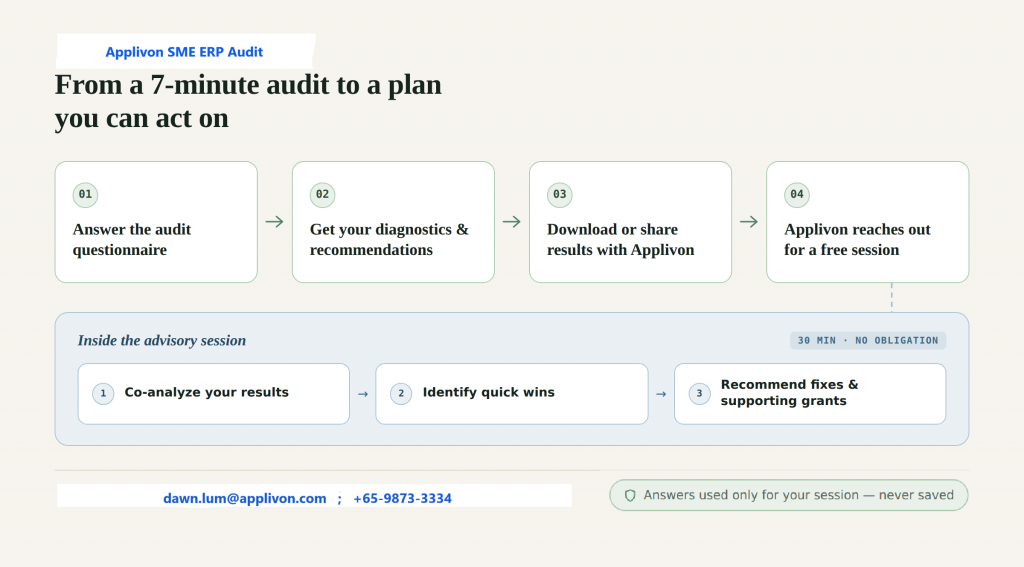
That’s exactly what the SME ERP Audit was designed for – a free, self-guided diagnostic for Singapore SMEs, before you commit to any project or vendor conversation. Answers and results are generated only for your session and are not saved, with options to download and share via email; no account creation, no data warehousing.
Clear-eye diagnostics and take it further
This simplified audit covers five areas where SMEs typically lose the most productivity: process automation, systems & integration, data quality, priorities & needs, and AI readiness.
Your results page gives you an overall digital operations score with category-by-category breakdown on “What you’re doing well” and “Where it is leaking” and recommends quick-win actions based on a three-phase roadmap.
after getting the clear-eyed view of your operations, use it as a practical conversation starter. You can share the results to your team and Applivon in one click.
We don’t stop there. The real value is when we reach out to you for a no-obligation assessment session to walk through what your specific results mean, what analyze quick wins and grant support options (PSG, EDG) – bringing a conversation and turn it into a plan.
Make fixes instead of expensive waits
Growing SMEs in Singapore are under real pressure right now ,tighter margins, tighter manpower, and a fast-moving digitalisation push across every sector. The businesses pulling ahead aren’t necessarily the ones with the biggest tech budgets. They’re the ones that know precisely where their operational leaks are, and fix the highest-impact ones first ,before those leaks get more expensive to fix.
You can’t fix what you haven’t diagnose in greater depths, evaluate options and size support availability, all with zero data risk.